
Supporting Best Practice through Reflecting on Personal Impact
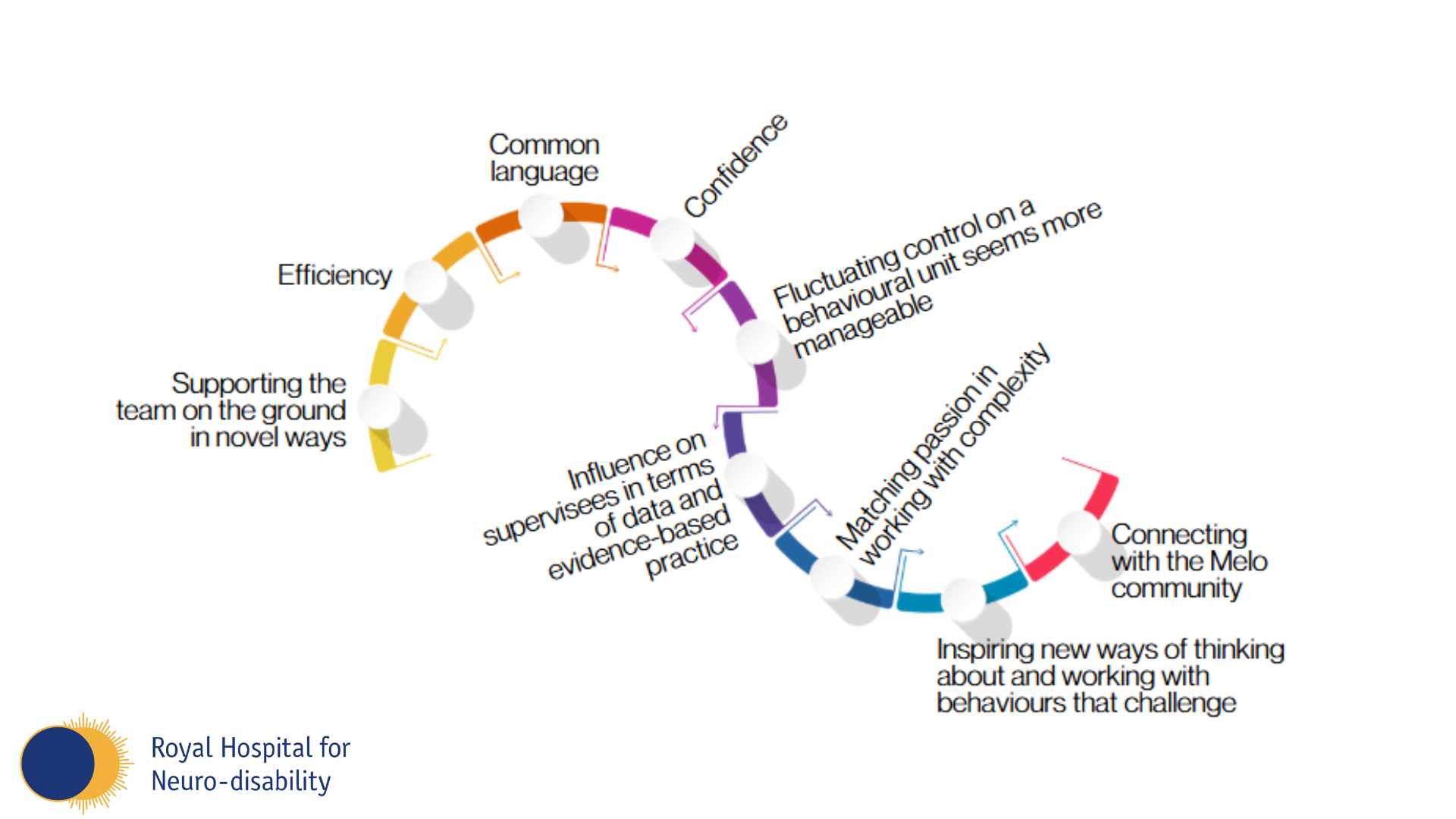
A visual shared by the Royal Hospital for Neuro-disability during our Clinical Best Practice Webinar, illustrating how reflecting on their personal impact and integrating Melo can help outline best practice.
In complex neurorehabilitation settings, best practice is a living process shaped by teams who reflect, adapt, and continually refine their approach to behavioural complexity.
During our recent Clinical Best Practice Webinar, Dr Natali Farran, Clinical Psychologist at Royal Hospital for Neuro-disability (RHN), shared a compelling perspective on how clinicians can grow their impact through reflective practice, shared language, and structured behavioural insight through adopting Melo into practice.
In this article, we explore the components highlighted in RHN’s presentation and how these principles come to life through the use of Melo.
1. Supporting the Team on the Ground
Everyday care in neurorehabilitation is dynamic and unpredictable. Traditional behavioural documentation often fails to capture the nuance that clinicians observe, leaving important insights buried in fragmented notes.
Melo addresses this gap directly by providing intuitive tools for real-time behavioural recording. Teams can quickly capture antecedents, behaviours, consequences, and contextual factors, creating a more coherent picture of patient experience. This supports day-to-day decision-making and helps staff feel heard, valued, and empowered.
2. Increasing Efficiency
Administrative workload continues to be one of the most significant pressures in healthcare. When documentation becomes heavy, reflective practice gets pushed to the margins.
Melo streamlines behavioural data collection, providing meaningful insights through charts, and intelligent analytics. This reduces duplication, removes manual collation, and allows multidisciplinary teams to focus on interpretation rather than data processing.
3. Establishing a Common Language
Behavioural care involves multiple disciplines: therapists, nurses, psychologists, support workers etc. Each bring different perspectives. Without a shared vocabulary, misalignment and inconsistency can easily arise.
Melo provides a shared language, enabling teams to communicate clearly, reduce ambiguity, and align interventions. This shared understanding ensures a personalised, consistent standard of care across disciplines.
4. Building Confidence
Confidence grows when clinicians can see the impact of their decisions reflected in data and outcomes.
Melo allows teams to visualise behavioural trends over time, identify patterns, and link interventions to measurable outcomes. This visibility supports individual decision-making and strengthens confidence across the entire team.
5. Making Fluctuating Control Manageable
Complex behaviours are rarely linear. Teams often experience cycles of escalation, plateau, and improvement that can feel unpredictable and emotionally demanding.
By graphically representing fluctuations and contextualising them within environmental or clinical changes, Melo helps teams step back and understand variability over time, supporting more informed and proactive interventions.
6. Enhancing Evidence-Based Supervision
Supervisors and senior clinicians often have to guide practice across multiple wards or services. Without accessible data, supervision risks becoming anecdotal or overly reliant on recall.
Melo provides supervisors with high-quality behavioural data that supports reflective discussion grounded in evidence. This strengthens clinical governance, enriches staff development, and creates opportunities for more impactful feedback.
7. Matching Passion with Complexity of Care
Clinicians working in neurorehabilitation are deeply motivated by patient connection and the desire to make meaningful change. Complexity is not a barrier to them, it is part of their purpose.
Melo equips these passionate teams with the structures required to operate confidently within complexity. The platform doesn’t replace clinical judgment; it enhances it by making patterns visible and decisions traceable. When passion is supported by insight, practice becomes more intentional and more effective.
8. Inspiring New Ways of Thinking
When clinicians can see how their actions influence behaviour, it drives a shift in cultural mindset. Melo acts as a catalyst for this shift.
By making data meaningful and reflection accessible, teams challenge unconscious habits, test hypotheses, and refine their therapeutic approaches.
9. Connecting with the Melo Community
Behavioural care improves fastest when professionals learn from one another. As more clinicians adopt Melo, a growing community is emerging; sharing insights, data-driven approaches, and best practice across services.
This collective intelligence is shaping a new standard for behavioural care: one grounded in evidence, consistency, and collaborative learning.
Conclusion
The ultimate message from RHN’s presentation is that reflecting on personal impact transforms practice. Tools like Melo make reflection visible, providing structure, shared language, and meaningful data to turn everyday observations into actionable insights.
By understanding our personal impact and working together, teams don’t just improve individual practice; they build collective best practice, strengthening skills, confidence, collaboration, and ultimately the quality of care delivered to individuals with complex behavioural needs.
