
Making the complexity of a patient's needs visible, and defensible
How the neuro-behavioural team at the Royal Hospital for Neuro-disability turned day-to-day behavioural observations into clear evidence for clinical decisions, and for the funding conversations that follow.
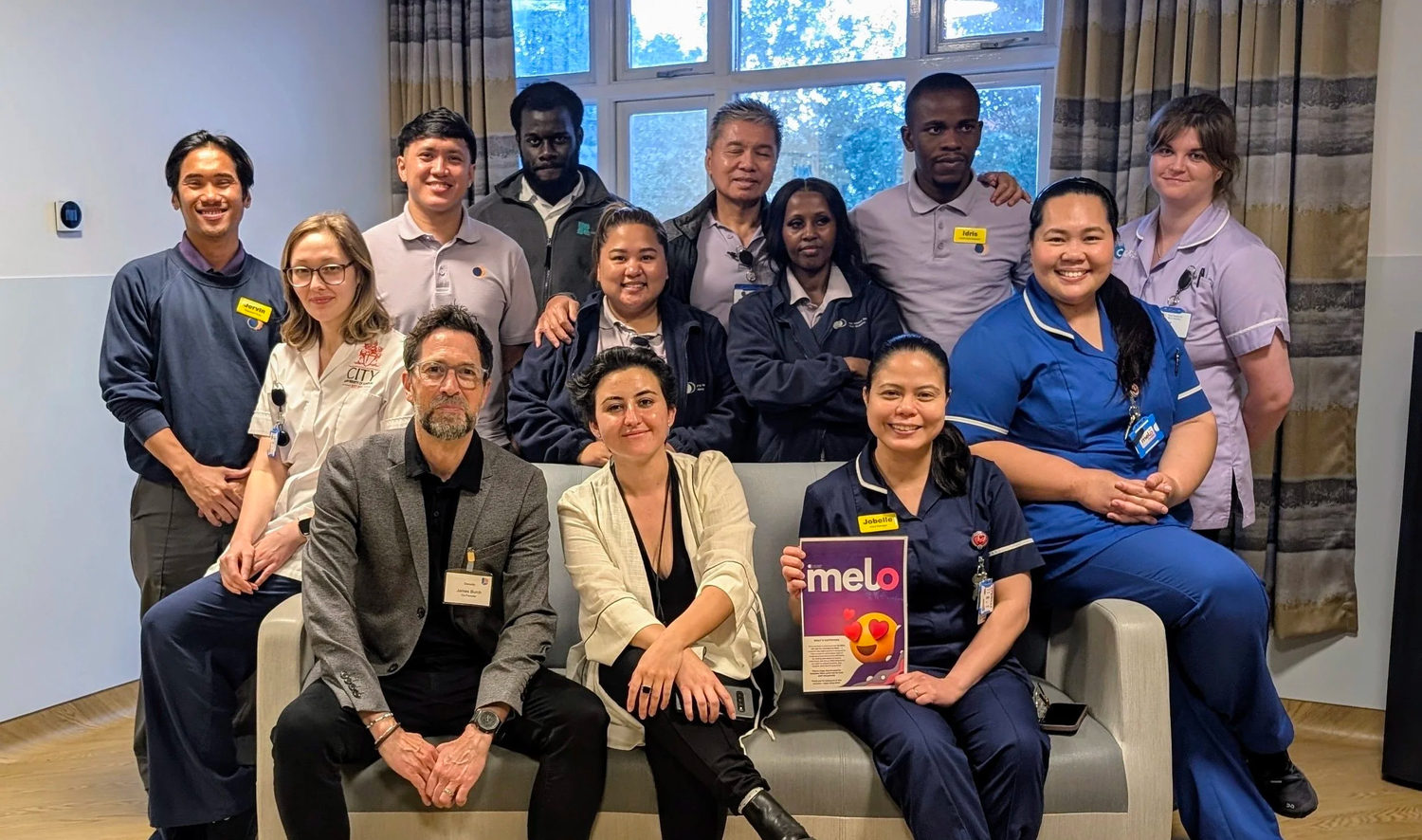
- Organisation
- Royal Hospital for Neuro-disability, Putney
- Service
- Wellesley Ward, Goodman House
- Using Melo since
- Early 2025
- Assessments used
- ABC, OAS-MNR and SASBA
assessments completed digitally
said Melo improved their ability to do their job
said Melo helped them identify behavioural trends
still in active use one year after go-live
Assessment volume: Melo platform data, as of August 2026. Survey figures: self-reported, one-year service evaluation, n=33. Active use: observed platform data.
When funding rests on evidence, the evidence has to be good
Understanding and evidencing complex behaviour in neurorehabilitation is difficult. On Wellesley Ward, clinicians regularly have to justify the need for 1:1 support to the Integrated Care Board, and those decisions determine whether funding continues. Without clear evidence, a patient can lose the support that keeps them safe, drives their rehabilitation and protects their quality of life.
- 01Complex behaviour is hard to describe on paper
- 02Funding decisions rest on that description
- 03Insight sat in reports, days after the event
- 04Ward observations stayed separate from the wider team's view
“We already record this somewhere”
Most services do. Before the Royal Hospital for Neuro-disability rolled Melo out, the team ran a direct comparison: the same ABC assessments, recorded in Melo and recorded in the electronic patient record they already had.
The improvement held among the most experienced staff, the group with the least to gain from a new system. Staff also reported better quality data and an easier system to use than the one they had.
rated Melo much faster than the EPR
rated Melo slower than the EPR
mean score out of five for time efficiency
Self-reported staff feedback, RHN initial efficiency trial, November 2024.
One record the whole ward can see
Since early 2025, the neuro-behavioural team at the Royal Hospital for Neuro-disability has used Melo to make sense of behavioural complexity. Clinicians capture behaviours and the interventions around them in a structured way, so day-to-day observations become something the team can read as a pattern rather than a pile of notes.
Nurses and carers record alongside psychology and therapy, and everyone sees the same picture. That supports decisions on the ward, and it gives the team evidence they can take to external partners like the Integrated Care Board. In practice it means less time chasing notes and more time with patients.
See a year of behavioural data on your own ward
Start a free trial and record with your own team, using the assessments you already run.
Four things the team noticed first
Earlier decisions
The team can act on behaviour as it happens rather than waiting for a psychology report to be written up. Interventions go in sooner, and the team can see whether they worked.
Real-time data, shared across the team
Opening the data up strengthened a whole-team approach. Nurses and carers see their own observations reflected in the picture the ward works from, which is a large part of why they keep recording.
A shared language
Melo gave the team consistent terms for behaviour that challenges, and captured the interventions and strategies around it more completely. Better data is the direct result. It also supports the team's commitment to reducing restrictive practice.
“Melo highlights the complexity of our patients on Wellesley Ward, something that's often very difficult to do with other means.”
Evidence for a funding case
For the first time, ward managers used Melo's behavioural charts to support a funding justification for 1:1 care. Clinicians described it as a more accurate and more defensible representation of what a patient actually needs.
What the evaluation found
Self-reported, one-year service evaluation, n=33. In the earlier trial phase, 100% of respondents rated the system easy or very easy to use, n=9.
- 4 daysfrom decision to activation
- 3 weeksto embed in routine practice, then scaled to a second ward
- 500assessments in the first two months, before full rollout
- 57 to 100%documentation accuracy within 15 days, sustained after that
Observed, implementation study. Accuracy audit: 57% on days 1 to 3, 85% on days 4 to 10, 100% by days 11 to 15.
From crisis management to meaningful recovery
A new patient was admitted presenting with severe behaviour that challenges, with significant consequences for other patients, for staff and for the ward environment. In one week, 83 episodes were recorded, including physical aggression, property damage and attempts to leave.
Seven days into the admission the patient's behaviour began to escalate. They were confused and disorientated, with severe communication impairment and cognitive difficulties.
The team completed digital ABC assessments daily in Melo. They needed to deliver key interventions to reorientate the patient without words, and without triggering an escalation, but there was no obvious window in which to do it.
Using Melo, the team identified the times of day when the patient was reliably settled, and delivered the interventions then rather than in the middle of an episode. Within days the patient was taking part in ward activities again, including playing table tennis.
Melo's time-of-day view. The pattern is what let the team pick their moment.
- AdmissionSevere behaviour that challenges, 83 episodes in a week
- Day 7Behaviour escalates, confusion and disorientation
- In MeloDaily ABC assessments recorded on the ward
- PatternSettled windows identified across the day
- OutcomeInterventions delivered, and back to ward activities
Try Melo with your own team.
Start free trialFrom the people using Melo

“I shared the Melo dashboard with a patient's family. They started looking at different days and thinking about strategies that can be put in place, as well as visiting days and times. They said that they loved the graphs, and that seeing the progress makes them feel hopeful despite all the challenges.”
- “Melo is such an important, useful and exciting development in the world of managing behaviour that challenges. It is a straightforward and clear app to track behaviour that challenges after brain injury. This will help us improve the data collection and how we utilise the data on our wards.”Dr Alex Rose, Consultant Clinical Psychologist and Neurobehavioural Programme Lead
- “It helps you put as much information in, in a short time. Reduces the chances of missing things.”Occupational Therapist
- “Simple, straightforward, convenient, effective. Everything on Melo is easier.”Health Care Assistant
Presented in Belfast and Dublin
Both pieces of work carry the hospital's name alongside ours. They were presented as datablitz sessions at NR-SIG-WFNR in Belfast on 19 and 20 July 2026, and as posters at the International Neuropsychological Society mid-year meeting in Dublin from 22 to 24 July.
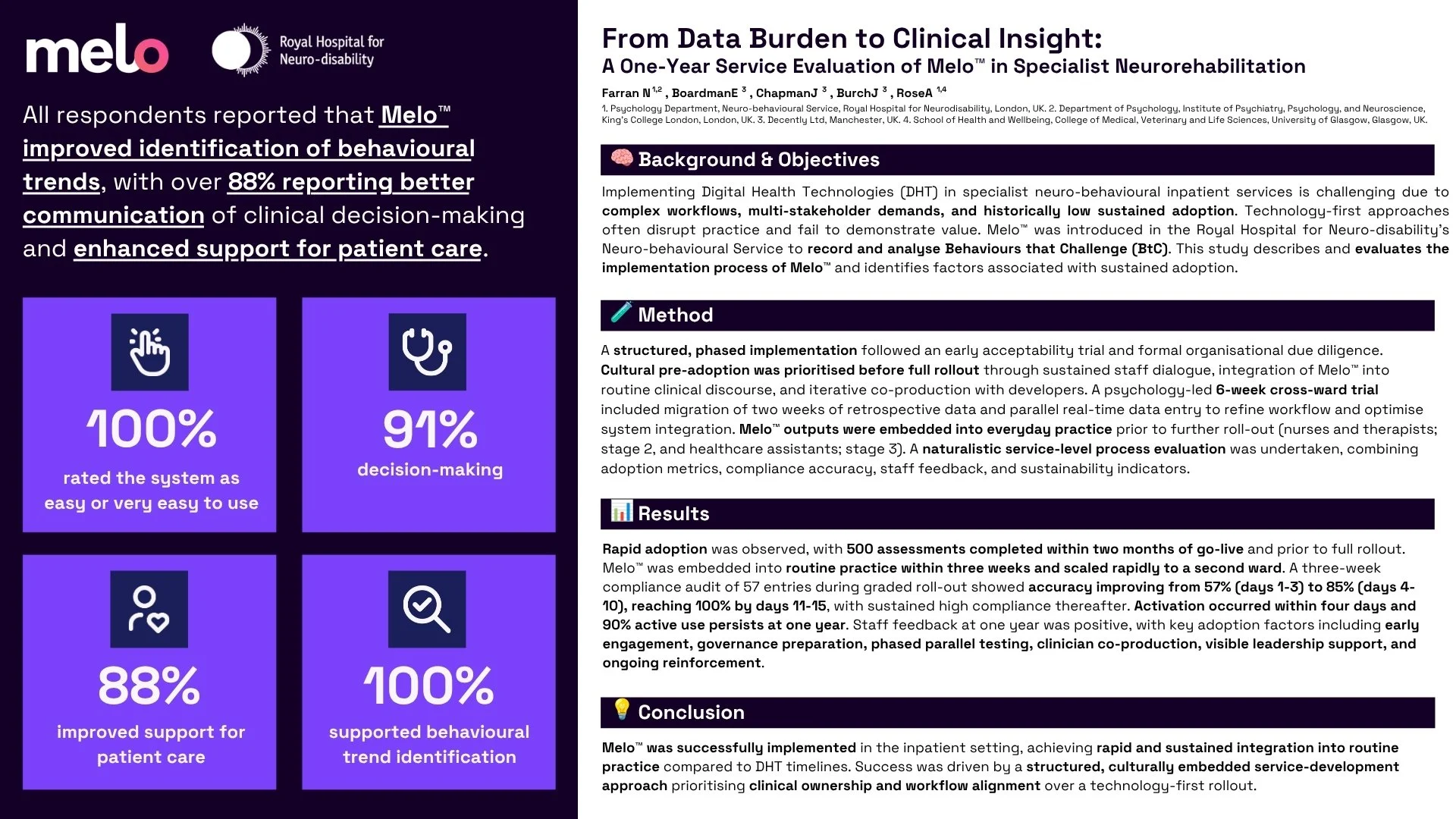
- Service evaluation
From Data Burden to Clinical Insight: A One-Year Service Evaluation of Melo in Specialist Neurorehabilitation
Presented by James Chapman. Mixed methods, with a pre-deployment trial phase (n=9) and a one-year follow-up (n=33).
- Implementation study
Service Development in Practice: Successfully Implementing Melo in a Specialist Neuro-behavioural Inpatient Service
Presented by Dr Natali Farran. A phased, psychology-led implementation with retrospective data review and co-production with clinicians.
What these numbers are, and what they are not
- Assessment volume comes from Melo platform data, as of August 2026.
- Survey figures are self-reported, from a one-year service evaluation (trial phase n=9, follow-up n=33) and an initial efficiency trial in November 2024.
- Adoption and documentation accuracy are observed, from an implementation study on the same ward.
- Findings come from one service. They may not generalise to other settings.
- Melo supports clinical judgement. It does not diagnose, recommend treatment or make decisions.
- Case study
NHS University Hospitals of Liverpool Group
Read the case study - Case studies
All case studies, evaluations and research
See all case studies - Governance
DTAC, DCB0129, DSPT and how we handle data
Go to the governance hub